
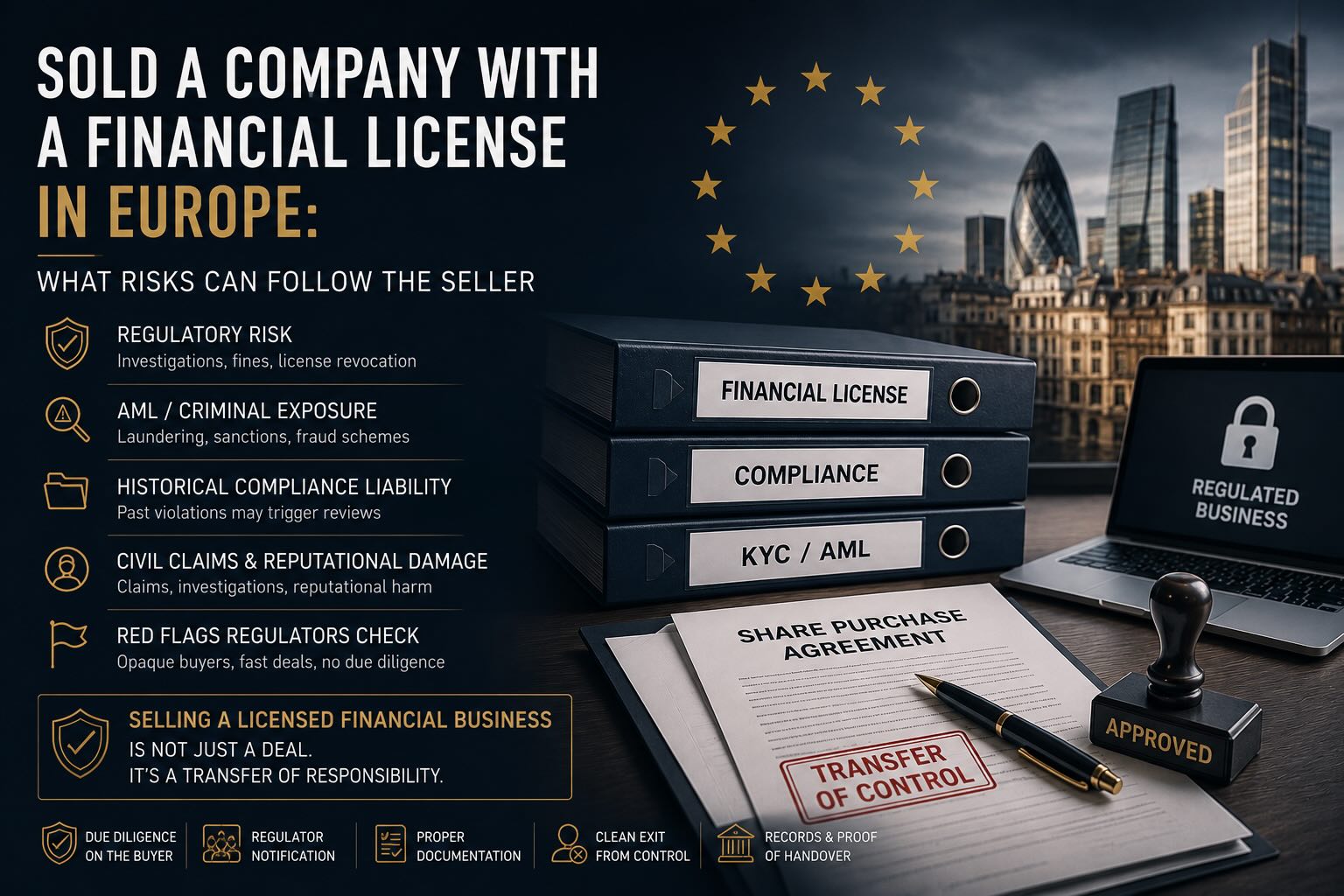
Sold an Active Company with a Financial License: What Risks May Continue to Follow the Seller?
Over the past few years, the market for ready-made fintech, EMI, crypto, and payment companies in Europe has grown dramatically. More entrepreneurs and investors now prefer acquiring already licensed entities instead of spending months — and often substantial resources — obtaining a license from scratch.
At first glance, such a transaction may appear to be a standard business sale: the parties sign a Share Purchase Agreement, transfer the shares, complete the payment, and move on.
However, when it comes to licensed financial companies, things work very differently.
Today, regulators, banks, payment providers, and AML authorities increasingly treat the sale of regulated entities not merely as a corporate transaction, but as a transaction with ongoing regulatory and compliance implications.
In many cases, attention to the former owner does not end once the deal closes. Regulatory scrutiny may continue for years after the seller has formally exited the business.
This is especially relevant for:
- EMI and Payment Institutions;
- crypto / VASP / CASP companies;
- brokerage and FX structures;
- lending businesses;
- payment infrastructure providers;
- other regulated financial entities.
The reason is straightforward: together with the company, the buyer receives not only a legal entity, but access to licensed infrastructure, banking relationships, payment rails, regulated activity, and potentially sensitive financial flows.
As a result, regulators increasingly focus not only on who acquires the company, but also on whether the seller conducted the exit responsibly and with sufficient due diligence.
Why the Sale of a Licensed Financial Company Is Different from an Ordinary M&A Deal
In a standard commercial business, a change of shareholders is often treated as an internal corporate matter.
In the regulated financial sector, however, a change of control almost always triggers broader regulatory concerns, including:
- AML/KYC obligations;
- fit & proper requirements;
- beneficial ownership transparency;
- change of control rules;
- regulator approvals and notifications;
- governance and compliance considerations.
In many European jurisdictions, regulators assess not only the company itself, but also the individuals who ultimately control it.
This means that the sale of a licensed entity is effectively viewed as the transfer of access to regulated financial activity.
That is precisely where the seller’s risk begins.
If, at a later stage, the new owner starts using the company for suspicious or illegal purposes, regulators and financial intelligence units will almost inevitably review:
- how the transaction was structured;
- who previously owned the company;
- whether proper buyer due diligence was conducted;
- whether any red flags were visible at the time of sale;
- whether the seller retained influence after closing.
Regulatory Risk: Why the Seller May Remain Inside the Regulatory Perimeter
One of the most common misconceptions is that once the SPA is signed and ownership changes hands, the seller automatically disappears from the regulator’s radar.
In reality, this is not always the case.
If a regulator believes that:
- the change of control was improperly conducted;
- required approvals were not obtained;
- regulator notifications were incomplete or misleading;
- the buyer did not satisfy fit & proper requirements;
- the seller effectively retained influence over the company,
then questions may arise not only for the new owner, but also for former shareholders, directors, MLROs, and compliance officers.
Regulators are particularly sensitive to situations where:
- the deal closes unusually quickly;
- the buyer’s ownership structure lacks transparency;
- nominee arrangements are used;
- the seller remains a director or signatory after closing;
- the company is effectively being sold as a “ready-made license” without real operational substance.
In many European jurisdictions, simply updating the shareholder register is not enough. Regulators focus on the actual transfer of effective control.
This is why attempts to “formally exit” while retaining hidden influence over the business are viewed extremely negatively.
AML and Criminal Exposure: The Most Serious Risk Area
The most dangerous category of risk involves AML and potential criminal exposure.
If, after the sale, the company becomes involved in:
- money laundering schemes;
- suspicious crypto flows;
- sanctions circumvention;
- payment fraud;
- unlicensed financial activity;
- processing of high-risk transactions,
authorities will often initiate a retrospective review of the company’s ownership history and the transaction itself.
The key question regulators and investigators may ask is:
“Should the seller have understood who they were transferring control of a licensed financial company to?”
Authorities become especially concerned where:
- nominee structures are involved;
- ownership chains are opaque;
- the source of funds is unclear;
- the buyer is connected to high-risk jurisdictions;
- the seller performed little or no KYC on the buyer;
- the transaction appears intentionally structured to avoid scrutiny.
Formally, the seller may no longer have any involvement with the company.
However, if regulators identify signs of:
- willful blindness;
- deliberate ignorance;
- negligent facilitation,
the risk of enforcement action increases significantly.
In some cases, authorities may argue that the seller knowingly — or at least negligently — facilitated the transfer of regulated infrastructure to questionable parties.
Historical Compliance Liability: Past Problems Do Not Disappear
Another serious misconception is that selling the company somehow “cleans” its historical compliance record.
In practice, after an acquisition, regulators, correspondent banks, or payment providers may initiate retrospective AML reviews covering periods when the company was still owned by the previous shareholder.
This often includes reviews of:
- weak onboarding procedures;
- incomplete KYC files;
- insufficient transaction monitoring;
- sanctions screening deficiencies;
- lack of proper source-of-funds verification;
- suspicious historical clients;
- weak governance controls.
In many situations, historical AML failures become the trigger for:
- regulatory investigations;
- banking restrictions;
- SAR filings;
- enhanced supervision;
- enforcement actions.
And where those failures relate to the period before the sale, regulators will naturally direct questions toward former management and previous owners.
Civil Claims and Reputational Exposure
Even where no formal regulatory action is initiated, the seller may still face serious reputational and civil risks.
For example, the buyer or investors may later allege:
- misrepresentation;
- hidden liabilities;
- undisclosed compliance deficiencies;
- inaccurate disclosures during negotiations;
- breach of warranties under the SPA.
In addition, the former owner’s name may appear in:
- media investigations;
- regulator correspondence;
- bank compliance reviews;
- enhanced due diligence reports;
- international compliance databases.
For professionals operating in the international financial sector, reputational damage can often be more harmful than formal penalties.
Future banking relationships, licensing applications, investors, and subsequent transactions are all heavily influenced by compliance reputation and perceived integrity.
Five Major Red Flags Regulators Focus on in Licensed Company Sales
1. Selling a “License” Instead of an Operating Business
If the company has:
- minimal operational activity;
- no real staff;
- weak substance;
- limited commercial rationale;
- a buyer interested primarily in the license and bank accounts,
regulators may treat the transaction as the transfer of a regulatory shell.
That automatically increases the AML sensitivity of the deal.
2. Opaque Buyer Structures
The use of:
- nominee shareholders;
- layered offshore structures;
- unverifiable UBOs;
- opaque trusts;
- complex holding chains,
almost always becomes a trigger point for regulatory scrutiny.
The regulator’s core question is:
“Who is actually obtaining control of the regulated entity?”
3. The Seller Remains Involved After Closing
This is one of the most common mistakes.
After the sale, the seller:
- remains a director;
- keeps banking access;
- remains a signatory;
- continues operational involvement;
- “temporarily helps manage” the company.
From a regulator’s perspective, this may look like a concealed control arrangement or an attempt to bypass fit & proper review requirements.
4. Lack of Proper KYC on the Buyer
Many sellers still believe that only the buyer is responsible for due diligence.
In the regulated financial sector, however, the seller must also demonstrate reasonable diligence — especially in fintech, crypto, payment infrastructure, and other licensed financial services businesses.
5. Unusual Deal Structures
Regulators and banks become especially concerned by:
- accelerated closings;
- crypto settlements;
- side agreements;
- unusual pricing structures;
- pressure to avoid regulator involvement;
- incomplete documentation.
For AML teams, abnormal transaction structures almost always indicate elevated risk.
What Sellers Should Do to Reduce Risk
Today, exiting ownership of a licensed financial company requires almost the same level of preparation as obtaining the license in the first place.
In practice, sellers should:
- conduct full buyer KYC;
- verify source of funds and sanctions exposure;
- document negotiations and handover procedures;
- formalize regulator notifications;
- revoke all banking access and signatory rights;
- clearly document the transfer of operational control;
- use detailed SPAs with robust representations, warranties, and indemnities;
- preserve evidence of compliance actions;
- implement a structured transition process.
The seller’s ultimate goal should be simple:
To be able, years later, to demonstrate that they acted in good faith and took reasonable steps when transferring control of a regulated business.
Conclusion
The sale of a licensed financial company in Europe is no longer an ordinary corporate transaction.
For regulators, banks, and AML authorities, it is a transaction with ongoing regulatory and compliance implications.
The question today is no longer simply whether such a company can be sold.
The real question is:
- whether the seller structured the exit properly;
- whether they can later demonstrate good faith and reasonable diligence;
- and whether the transaction itself could eventually become the source of future regulatory, banking, or AML-related scrutiny years after closing.